Case Study: How We Created a Full Specification for a SaaS Platform in 3 Weeks
A real-world example of rapid, structured SaaS requirement documentation that delivered results
The Challenge
The Startup Dilemma
A fast-growing fintech startup approached us with an ambitious goal: launch their SaaS platform within four months. But they faced a critical problem—no clear product requirements document existed. Their development team was ready to build, investors were waiting for progress updates, and potential customers were asking for demos. The clock was ticking.
The challenge? Create a comprehensive Software Requirements Specification (SRS) that would serve as the single source of truth for developers, designers, QA testers, and stakeholders—all within three weeks.
In today's competitive SaaS landscape, speed to market is everything. Yet rushing into development without proper specifications is like building a house without blueprints. According to industry research, projects with well-defined requirements are 35% more likely to meet their original deadlines and 40% less likely to experience scope creep.
This case study reveals our proven three-week process for creating a complete SaaS specification document—a methodology that balances thoroughness with agility, and has since been replicated across multiple successful projects.
Project Context: Understanding the Product
The client, which we'll call "FinanceFlow" (name changed for confidentiality), was building a B2B SaaS platform designed to help small businesses manage cash flow forecasting and financial planning. Their target users were finance managers and small business owners who needed real-time insights without the complexity of enterprise accounting software.
Target Market
Small to medium businesses (10-200 employees) in North America
Key Differentiator
AI-powered forecasting with automated bank integrations
Business Model
Subscription-based ($49-$299/month tiers)
MVP Timeline
4 months from specification completion
The founding team consisted of two co-founders with financial backgrounds but limited technical expertise. They had raised seed funding and assembled a remote development team, but lacked the structured documentation needed to align everyone toward a common goal.
Our Three-Week Framework
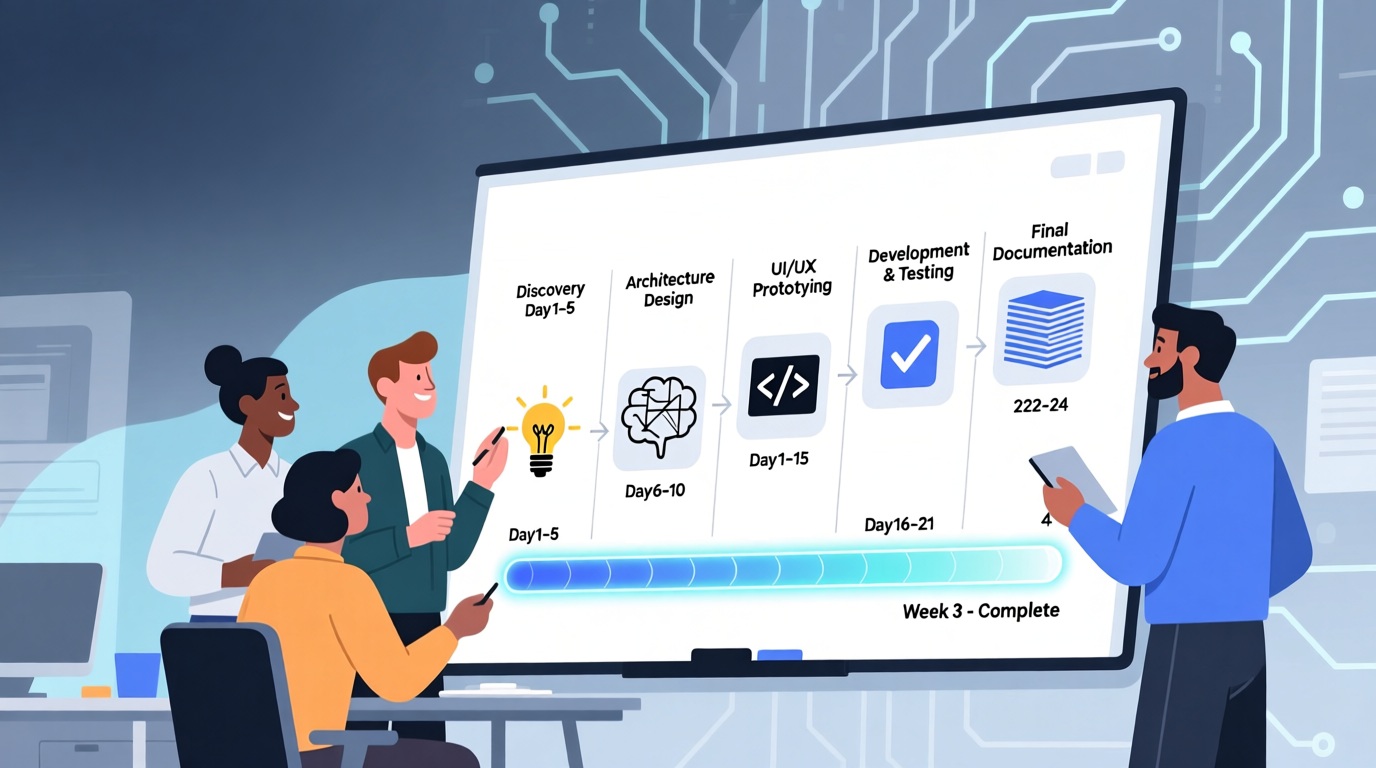
We developed an agile, sprint-based approach to requirements gathering that compressed what traditionally takes 6-8 weeks into just three intensive weeks. Here's exactly how we did it:
Discovery
Foundation & Research Phase
- Stakeholder interviews with founders, technical lead, and 5 potential customers
- Competitive analysis of 8 similar platforms
- User persona development (created 3 detailed personas)
- Technical feasibility assessment
- Initial product vision documentation
- Risk identification workshop
Definition
Requirements Documentation Phase
- Functional requirements breakdown (87 core features identified)
- Non-functional requirements definition (performance, security, scalability)
- User story mapping (147 user stories created)
- System architecture design
- API specification drafting
- Data model creation
- Daily review sessions with stakeholders
Refinement
Validation & Finalization Phase
- Requirements prioritization using MoSCoW method
- Technical specification completion
- Wireframe and user flow validation
- Development roadmap creation
- Test plan outline
- Final stakeholder presentation and approval
- Handoff documentation for development team
Ready to Accelerate Your SaaS Specification Process?
Let our team help you create a comprehensive requirements document that sets your project up for success
Get Started TodayTraditional vs. Agile Specification Approach
What made our three-week timeline possible? We abandoned the traditional waterfall approach to requirements gathering and embraced an agile, iterative methodology. Here's how the two approaches compare:
Traditional Approach
Timeline: 6-12 weeks
- Sequential phases with limited overlap
- Extensive upfront documentation
- Minimal stakeholder involvement after initial interviews
- Single approval gate at the end
- High risk of misalignment
Our Agile Approach
Timeline: 3 weeks
- Parallel workstreams with daily synchronization
- Just-enough documentation philosophy
- Continuous stakeholder feedback loops
- Multiple validation checkpoints
- Rapid iteration and refinement
Key Methodologies That Made It Work
1. Cross-Functional Collaboration from Day One
We assembled a core specification team that included:
- Product Manager: Led the overall process and stakeholder communication
- Senior Developer: Provided technical feasibility input in real-time
- UX Designer: Created wireframes and user flows concurrently
- Business Analyst: Documented requirements and maintained traceability
- QA Lead: Defined acceptance criteria and test scenarios
This cross-functional approach eliminated the traditional handoff delays between different specialists. Instead of sequential work, we had parallel streams that converged daily.
2. The "Just-Enough Documentation" Philosophy
One of our core principles was avoiding documentation bloat. We focused on creating specifications that were comprehensive enough to guide development, but concise enough to be maintainable. Every requirement had to answer three questions:
- What problem does this solve for the user?
- How will we know when it's successfully implemented?
- What are the critical edge cases we must handle?
If a requirement couldn't clearly answer these questions, it was either refined or descoped.
3. Daily Validation Loops
Every afternoon at 4 PM, we held a 30-minute validation session with key stakeholders. This wasn't a status update meeting—it was an active working session where we:
- Reviewed requirements documented that day
- Resolved ambiguities immediately
- Made prioritization decisions
- Adjusted course based on new insights
These daily touchpoints prevented the "big reveal" syndrome where weeks of work get invalidated in a single review meeting.
4. User Story Mapping for Clarity
Rather than creating a flat list of requirements, we used user story mapping to organize functionality around user journeys. This technique helped us:
- Identify gaps in the user experience
- Prioritize features based on user value
- Visualize the product from the user's perspective
- Create a shared understanding across technical and non-technical team members
"The user story mapping session was a game-changer. For the first time, our technical team and business team were literally on the same page, looking at the same visual representation of our product."
What We Actually Delivered
At the end of three weeks, we delivered a complete specification package that included:
Master SRS Document
67-page comprehensive specification with functional and non-functional requirements
User Personas
3 detailed personas with goals, pain points, and behavioral patterns
User Story Map
147 user stories organized by user journey with acceptance criteria
System Architecture
High-level architecture diagram with technology stack recommendations
API Specifications
RESTful API documentation for 23 core endpoints
Wireframes
34 wireframes covering all major user flows
Development Roadmap
4-month phased implementation plan with milestones
Test Strategy
QA approach with test scenarios for critical functionality
See How Our Process Can Transform Your Project
Explore more real-world examples and discover how structured specification saves time and budget
View More Use CasesResults & Impact
The proof of any specification process is in the outcomes it enables. Here's what happened after we completed the three-week specification:
On-Time Delivery
Development team launched MVP in 3.8 months (5% ahead of schedule) with 94% of planned features
Zero Scope Creep
Not a single feature was added mid-development that wasn't in the original specification
Reduced Rework
Only 12% of development time spent on rework (industry average is 35-40%)
Team Alignment
Post-launch survey showed 96% team confidence that they built "the right product"
Investor Confidence
Secured additional funding round based on clear product roadmap and specification
Customer Validation
Beta users reported 89% satisfaction with core feature set, validating our requirement prioritization
Perhaps most importantly, the development team reported having a "clear north star" throughout the build process. When questions arose, the specification document provided answers. When trade-offs were necessary, the prioritization framework gave them guidance.
Lessons Learned: What Made This Work
Critical Success Factors
Reflecting on this project, several factors were absolutely essential to our success:
Stakeholder Availability
The client committed to being available for daily check-ins. This wasn't optional—it was fundamental. Projects where stakeholders are "too busy" to participate regularly will always struggle, regardless of the methodology.
Empowered Decision-Making
We had direct access to decision-makers who could approve or reject requirements on the spot. No decisions needed to go through multiple layers of approval, which would have added days or weeks to our timeline.
Technical Expertise on the Team
Having a senior developer involved from day one meant we never documented requirements that were technically impossible or economically impractical. This prevented costly discoveries later in the development cycle.
Scope Discipline
We were ruthless about protecting scope. Every "wouldn't it be nice if..." was documented in a future enhancements backlog, but kept out of the MVP specification. This discipline was uncomfortable at times, but essential.
Tool Choice
We used modern collaboration tools (Miro for user story mapping, Confluence for documentation, Figma for wireframes) that enabled real-time collaboration. Traditional tools like Word documents passed back and forth via email would have been impossible at this pace.
Can You Replicate This Process?
Absolutely—but with some important caveats. This three-week timeline works best when:
- Product complexity is moderate: A B2B SaaS with 10-15 major feature areas is ideal. Enterprise platforms with complex integrations may need 4-6 weeks.
- Team is available full-time: Our core team worked dedicated hours on this specification. Part-time attention will extend the timeline.
- Stakeholders can commit: If key decision-makers can only meet weekly, add at least one week to the process.
- Product vision is relatively clear: We're refining and documenting an existing vision, not discovering it from scratch.
- Team has specification experience: This isn't a beginner-friendly timeline. Experienced business analysts and product managers can move much faster.
Adaptation Guidance
If your situation differs, consider these adjustments:
- Complex enterprise platform: Use a 4-week timeline with an extra week for integration specifications
- Part-time team availability: Stretch to 5-6 weeks with 2-3 working sessions per week
- Unclear product vision: Add a 1-week discovery sprint before starting the three-week specification process
- Multiple stakeholder groups: Build in extra validation time and expect 4-5 weeks total
Best Practices for Fast SaaS Specification
Based on this project and subsequent replications, here are our top recommendations for anyone undertaking a rapid SaaS specification process:
Start with "Why" Not "What"
Begin every specification session by clarifying the problem you're solving, not the features you're building. Understanding the "why" makes the "what" much clearer and helps you prioritize ruthlessly.
Use Templates and Frameworks
Don't reinvent the wheel. We used established templates for user personas, user stories, and technical specifications. This provided structure and saved hours of formatting time.
Document Decisions, Not Just Requirements
For every major requirement decision, we captured the rationale. Six months later, when someone asked "why did we do it this way?", the answer was in the documentation.
Build in Buffer Time
Our three-week timeline actually had about 15% buffer built in. We planned for 18 days of active work within 21 calendar days, anticipating some unexpected delays.
Celebrate Small Wins
Completing a major section, getting stakeholder approval on a complex feature, resolving a long-standing ambiguity—we celebrated these milestones. It kept team morale high during an intensive process.
Conclusion: Speed Without Compromise
Creating a comprehensive SaaS specification in three weeks is absolutely achievable—but it requires discipline, collaboration, and the right approach. Our success with FinanceFlow wasn't luck; it was the result of a proven methodology that balances thoroughness with agility.
The key insight is that speed and quality aren't opposites. By involving the right people, using iterative validation, and maintaining scope discipline, you can create specifications that are both fast and comprehensive. The traditional approach of taking months to document requirements often results in documentation that's outdated before development even begins.
In today's competitive SaaS landscape, the ability to move from idea to specification to MVP quickly can be a significant competitive advantage. But that speed must be built on a foundation of clarity, not chaos. Our three-week framework provides that foundation.
"This specification process didn't just save us time—it saved our entire project. We went from confused and scattered to focused and aligned in three weeks. It was the best investment we made in our product development journey."
Whether you're a startup racing to market, an enterprise launching a new product line, or anywhere in between, the principles outlined in this case study can help you create specifications that drive successful outcomes. The question isn't whether you can afford to spend three weeks on specifications—it's whether you can afford not to.
Transform Your SaaS Specification Process
Ready to create a comprehensive specification that accelerates your development timeline? Our team has refined this three-week process across dozens of successful projects. Let's discuss how we can help you achieve similar results.
Schedule a Consultation