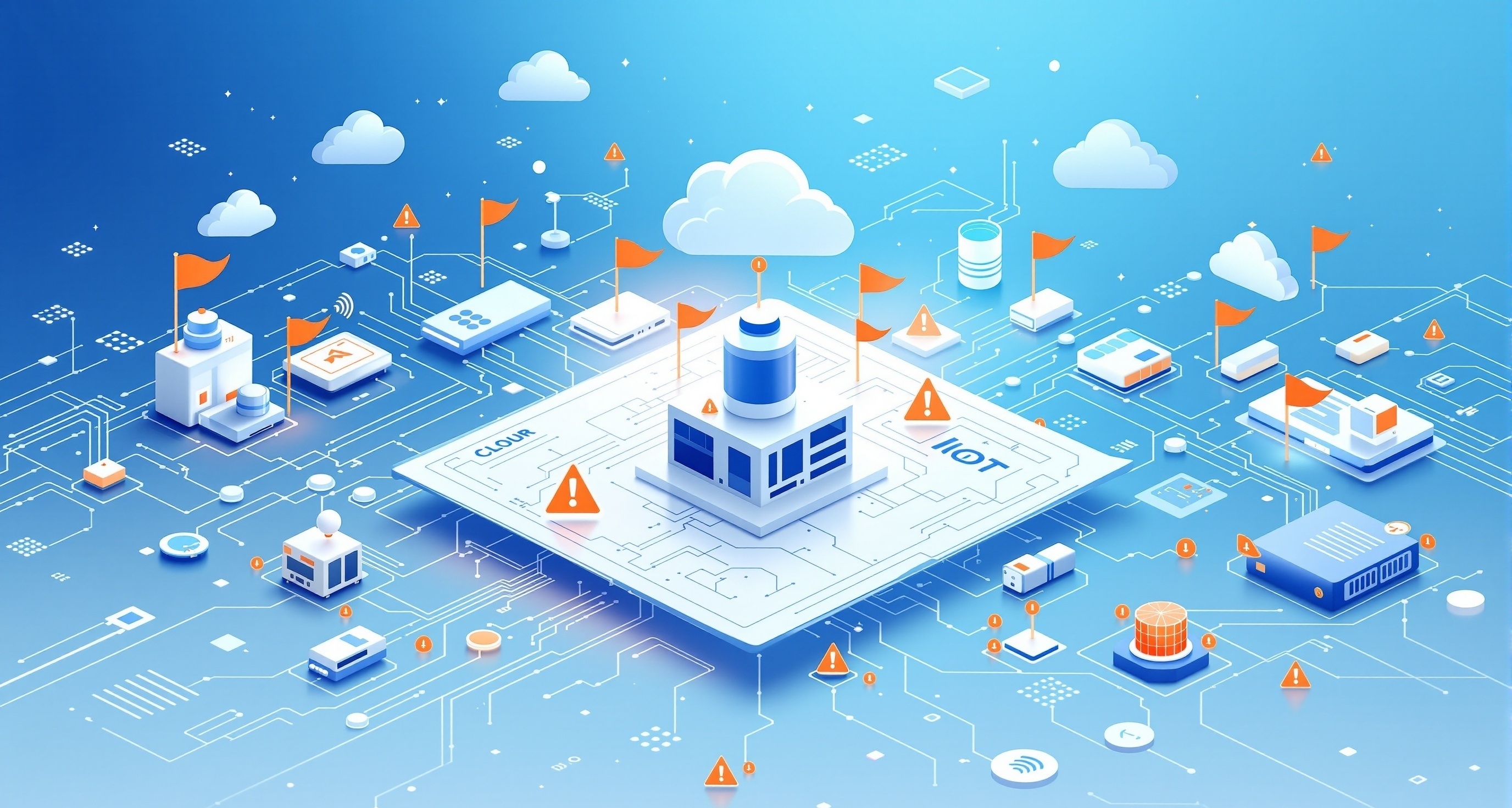
Unlike traditional IT solutions such as CRM systems or eCommerce platforms, IoT ecosystems are inherently complex, multi-layered constructs where devices, connectivity protocols, data pipelines, cloud infrastructure, and user interfaces must work in perfect harmony. A single miscalculation during the scoping phase can cascade into spiraling costs, security vulnerabilities, scalability nightmares, and ultimately, project failure.
This comprehensive guide examines the most critical architecture mistakes that kill IoT projects during scoping, backed by industry research and real-world examples. More importantly, we'll provide actionable solutions to help founders, CTOs, and project leaders architect IoT solutions that scale successfully.
Understanding the IoT Architecture Challenge
Before diving into specific mistakes, it's crucial to understand what makes IoT architecture uniquely challenging. Unlike monolithic software applications, IoT solutions are distributed ecosystems comprising multiple layers:
Each layer introduces complexity, potential failure points, and interdependencies that must be carefully planned during project scoping. Neglecting any single layer can compromise the entire system.
The 7 Critical Architecture Mistakes
Ignoring Scalability from Day One
According to Gartner, 75% of IoT projects fail due to poor scalability planning. Many development teams focus on building a working prototype without considering how the system will handle exponential growth in connected devices, data volumes, and concurrent users.
During project scoping, teams often make conservative estimates: "We'll start with 100 devices and see how it goes." But when those 100 devices become 10,000, the architecture crumbles under pressure. Database queries slow to a crawl, API endpoints timeout, and cloud costs spiral out of control.
⚠️ Real-World Impact:
- System crashes when device count exceeds initial projections
- Database performance degradation requiring expensive re-architecture
- Inability to onboard new customers due to infrastructure limitations
- Astronomical cloud bills that destroy unit economics
✅ Solution: Design for Scale from Project Scoping
- Plan for 10x growth: Whatever your initial device count estimate, architect for at least 10 times that number
- Adopt microservices architecture: Break monolithic systems into independently scalable services
- Use time-series databases: Implement InfluxDB, TimescaleDB, or similar solutions optimized for IoT data patterns
- Implement horizontal scaling: Design systems that can scale out by adding more instances rather than scaling up
- Edge-heavy, cloud-light approach: Process and filter data at the edge, sending only critical information to the cloud
Security as an Afterthought
McKinsey reports that 60% of IoT security vulnerabilities stem from poor security practices during development. Yet, security is frequently relegated to the "we'll handle that later" category during project scoping. This mindset is catastrophic in IoT, where devices often operate in hostile environments, handle sensitive data, and provide entry points into broader enterprise networks.
Recent studies show that 46% of US companies using IoT solutions have experienced at least one security breach, with the average cost reaching 13.4% of total annual revenue for businesses earning $5 million per year.
⚠️ Real-World Impact:
- Data breaches exposing customer personal information and intellectual property
- Device hijacking enabling DDoS attacks and botnet formations
- Regulatory non-compliance resulting in fines and legal action
- Irreparable brand damage and loss of customer trust
- Inability to retrofit security into deployed devices
✅ Solution: Security by Design
- End-to-end encryption: Implement TLS/SSL for data in transit and AES-256 for data at rest
- Device authentication: Use X.509 certificates and mutual TLS authentication for all device connections
- Secure boot and firmware signing: Ensure only authenticated firmware can run on devices
- Regular security audits: Build security testing into your development lifecycle from day one
- Over-the-air (OTA) update capability: Plan for secure remote firmware updates to patch vulnerabilities
- Network segmentation: Isolate IoT devices from critical enterprise systems
Hardware-Software Team Misalignment
A Forrester survey revealed that 40% of IoT project failures stem from misalignment between hardware and software teams. During project scoping, these teams often work in silos with different timelines, specifications, and understanding of system requirements.
The hardware team designs a device with specific sensor capabilities and power constraints, while the software team builds cloud infrastructure assuming different data formats and transmission frequencies. When these components finally meet during integration, incompatibilities emerge, requiring costly redesigns and延长project timelines.
⚠️ Real-World Impact:
- Mismatched data formats requiring extensive translation layers
- Communication protocol incompatibilities discovered during integration
- Power consumption exceeding battery capacity due to software demands
- Costly hardware redesigns or software rewrites late in the project
- Extended time-to-market missing competitive windows
✅ Solution: Unified Architecture Planning
- Joint scoping sessions: Bring hardware, firmware, and software teams together from the very first planning meeting
- Interface-first design: Define data formats, communication protocols, and API contracts before any implementation begins
- Regular integration testing: Implement continuous integration across the entire stack, not just within software
- Shared documentation: Maintain a single source of truth for system architecture accessible to all teams
- Appoint a systems architect: Designate someone responsible for end-to-end system coherence
Underestimating Data Management Complexity
IoT systems generate massive volumes of time-series data—temperature readings every second, location updates every minute, sensor arrays producing hundreds of data points per device. Yet, project scoping often treats data management as a simple "store in database" checkbox.
The reality is far more complex. Data must be ingested at high velocity, validated for quality, stored efficiently, retained according to regulatory requirements, analyzed for insights, and purged when appropriate. Without proper data architecture, most projects use less than half their collected data, wasting both storage costs and business opportunities.
⚠️ Real-World Impact:
- Database costs exceeding revenue from devices
- Slow query performance rendering analytics unusable
- Data quality issues undermining machine learning initiatives
- Regulatory compliance failures due to improper data retention
- Inability to extract business value from collected data
✅ Solution: Comprehensive Data Strategy
- Edge processing and aggregation: Filter and summarize data at the edge before cloud transmission
- Hot-warm-cold storage tiers: Implement data lifecycle management moving older data to cheaper storage
- Time-series optimization: Use databases specifically designed for IoT workloads (InfluxDB, TimescaleDB)
- Data governance framework: Define retention policies, access controls, and compliance requirements during scoping
- Analytics-first design: Plan analytics and visualization requirements before choosing storage solutions
No Over-the-Air (OTA) Update Strategy
Shipping IoT devices without OTA update capability is like launching a software product with no way to deploy patches. Yet, many projects treat firmware updates as a "nice to have" feature that can be added later. This mistake becomes catastrophic when security vulnerabilities are discovered, features need updating, or bugs require fixing in deployed devices.
Without OTA updates, companies face expensive device recalls, manual update procedures requiring technician visits, or simply leaving devices with known issues in the field. More than 80% of IoT projects fail because of device-level issues, many of which could be resolved with proper OTA infrastructure.
⚠️ Real-World Impact:
- Security vulnerabilities that cannot be patched remotely
- Costly physical recalls or technician dispatch for updates
- Feature limitations frozen at manufacturing time
- Competitive disadvantage as other products evolve while yours stagnates
- Customer dissatisfaction with buggy, unchangeable devices
✅ Solution: OTA from Day One
- Build OTA into firmware architecture: Design dual-boot partitions and rollback capabilities from the start
- Secure update mechanism: Implement signed firmware packages and encrypted transmission channels
- Staged rollout capability: Plan infrastructure for testing updates on small device cohorts before mass deployment
- Update management platform: Use tools like Mender, Balena, or AWS IoT Device Management
- Delta updates: Minimize bandwidth and time by transmitting only changed code sections
Vendor Lock-In and Technology Tunnel Vision
During project scoping, teams often commit entirely to a single cloud provider (AWS, Azure, Google Cloud) or proprietary platform without considering future flexibility. While these platforms offer excellent IoT services, complete dependence creates strategic vulnerabilities.
When pricing models change, service terms evolve, or business requirements shift, companies find themselves trapped. Migrating an IoT system with thousands of deployed devices from one platform to another is exponentially more difficult than planning for abstraction from the beginning.
⚠️ Real-World Impact:
- Inability to negotiate pricing as you're captive to one vendor
- Service limitations constraining your product roadmap
- Massive migration costs if vendor relationship deteriorates
- Geographic expansion blocked by vendor service availability
- Technology obsolescence if vendor discontinues services
✅ Solution: Vendor-Agnostic Architecture
- Abstraction layers: Create middleware that isolates business logic from cloud-specific APIs
- Open protocols: Use MQTT, CoAP, HTTP rather than proprietary communication methods
- Containerization: Deploy services in Docker containers that run anywhere
- Multi-cloud readiness: Even if starting with one provider, design for potential multi-cloud deployment
- Open-source foundations: Build on tools like Mosquitto, InfluxDB, Grafana that aren't tied to specific vendors
Overlooking Real-Time Processing Requirements
IDC reports that 30% of IoT applications struggle with real-time data processing due to inadequate backend infrastructure. During scoping, teams often assume "we'll just send data to the cloud and process it there" without considering latency requirements, connectivity reliability, or edge computing needs.
For many IoT use cases—industrial automation, autonomous vehicles, healthcare monitoring, security systems—milliseconds matter. Round-trip communication to distant cloud servers simply cannot meet these requirements, yet the architecture is designed without considering local processing capabilities.
⚠️ Real-World Impact:
- Safety-critical decisions delayed by network latency
- System failures when internet connectivity is unavailable
- Poor user experience due to slow response times
- Excessive bandwidth consumption from unnecessary data transmission
- Inability to serve use cases requiring immediate action
✅ Solution: Edge-First Architecture
- Identify latency-sensitive operations: During scoping, categorize which decisions require immediate action
- Edge computing infrastructure: Deploy processing capability at or near devices using edge gateways
- Intelligent data filtering: Process data locally, transmitting only anomalies, summaries, or significant events
- Offline operation modes: Design systems to continue functioning during connectivity outages
- Fog computing architecture: Distribute processing across edge, fog, and cloud layers based on latency requirements
Ready to Scope Your IoT Project Correctly?
Don't let architecture mistakes doom your IoT initiative. Our experts have helped dozens of companies design scalable, secure, and successful IoT solutions from the ground up.
Get Expert Architecture ConsultationBest Practices for Successful IoT Architecture Scoping
Avoiding mistakes is only half the battle. Here are proactive best practices that separate successful IoT projects from the 75% that fail:
⚠️ Critical Warning
The most expensive IoT architecture mistakes are the ones you don't discover until thousands of devices are deployed in the field. Fixing a security vulnerability in a deployed fleet can cost 10-100x more than implementing proper security during initial development. The time spent on thorough scoping is always cheaper than post-deployment rearchitecture.
The Right Architecture Decision Framework
When making architecture decisions during project scoping, use this framework to evaluate options:
| Decision Area | Wrong Approach | Right Approach |
|---|---|---|
| Device Connectivity | "We'll use whatever protocol is easiest" | Evaluate MQTT, CoAP, HTTP based on bandwidth, latency, and power requirements |
| Data Storage | "Relational database handles everything" | Time-series DB for sensor data, relational for metadata, object storage for files |
| Processing Location | "Send all data to cloud for processing" | Edge for real-time decisions, cloud for complex analytics and ML training |
| Security Model | "Add SSL and we're secure" | Multi-layer security with device authentication, encrypted storage, and network segmentation |
| Scalability Planning | "We'll handle that when we grow" | Design for 10x projected growth from day one |
| Update Strategy | "Hardware is final at manufacturing" | OTA updates with rollback capability built into firmware architecture |
Building Your IoT Architecture Scoping Checklist
Use this comprehensive checklist during your next IoT project scoping session:
🎯 Key Takeaways
- 75% of IoT projects fail, primarily due to architecture mistakes made during initial scoping
- Scalability must be planned from day one—retrofitting for scale is exponentially more expensive
- Security cannot be an afterthought—60% of vulnerabilities stem from poor development practices
- Hardware and software teams must align early to avoid costly integration failures
- Data management strategy separates successful IoT initiatives from those drowning in unusable data
- OTA update capability is non-negotiable for any serious IoT product
- Vendor lock-in creates strategic vulnerabilities that limit future flexibility
- Edge computing is essential for real-time, latency-sensitive applications
See How We Can Help Your IoT Project Succeed
Every successful IoT deployment starts with solid architecture. Explore our proven use cases and see how we've helped companies across industries build IoT solutions that scale, perform, and deliver ROI.
Explore Our IoT Use CasesConclusion: Architecture Success Starts at Scoping
The IoT revolution promises unprecedented connectivity, automation, and intelligence across every industry. Yet, the gap between IoT's promise and reality remains stubbornly wide, with three-quarters of projects failing to deliver expected value.
This failure rate isn't due to technical impossibility or market immaturity. The technology exists. The market is eager. What's missing is disciplined, thoughtful architecture planning during the critical project scoping phase.
The seven mistakes outlined in this guide—ignoring scalability, treating security as an afterthought, allowing team misalignment, underestimating data complexity, skipping OTA planning, accepting vendor lock-in, and overlooking real-time requirements—account for the vast majority of IoT failures. Yet, every single one is avoidable with proper planning.
Successful IoT companies understand that architecture isn't just technical drawings and technology selection. It's the foundation that determines whether your product scales gracefully or collapses under growth, whether it becomes a security liability or a trusted solution, whether it adapts to market changes or becomes obsolete.
The time invested in comprehensive architecture scoping isn't overhead—it's the most valuable investment you'll make in your IoT initiative. Because retrofitting good architecture after deployment isn't just expensive; it's often impossible.
Your IoT project's success or failure is largely determined before a single line of code is written or device manufactured. Choose your architecture foundation wisely.
Need Expert Guidance?
Don't navigate IoT architecture challenges alone. Our team has successfully scoped and delivered dozens of IoT projects across industries. Let's discuss how we can help you avoid these costly mistakes and build an IoT solution that scales.