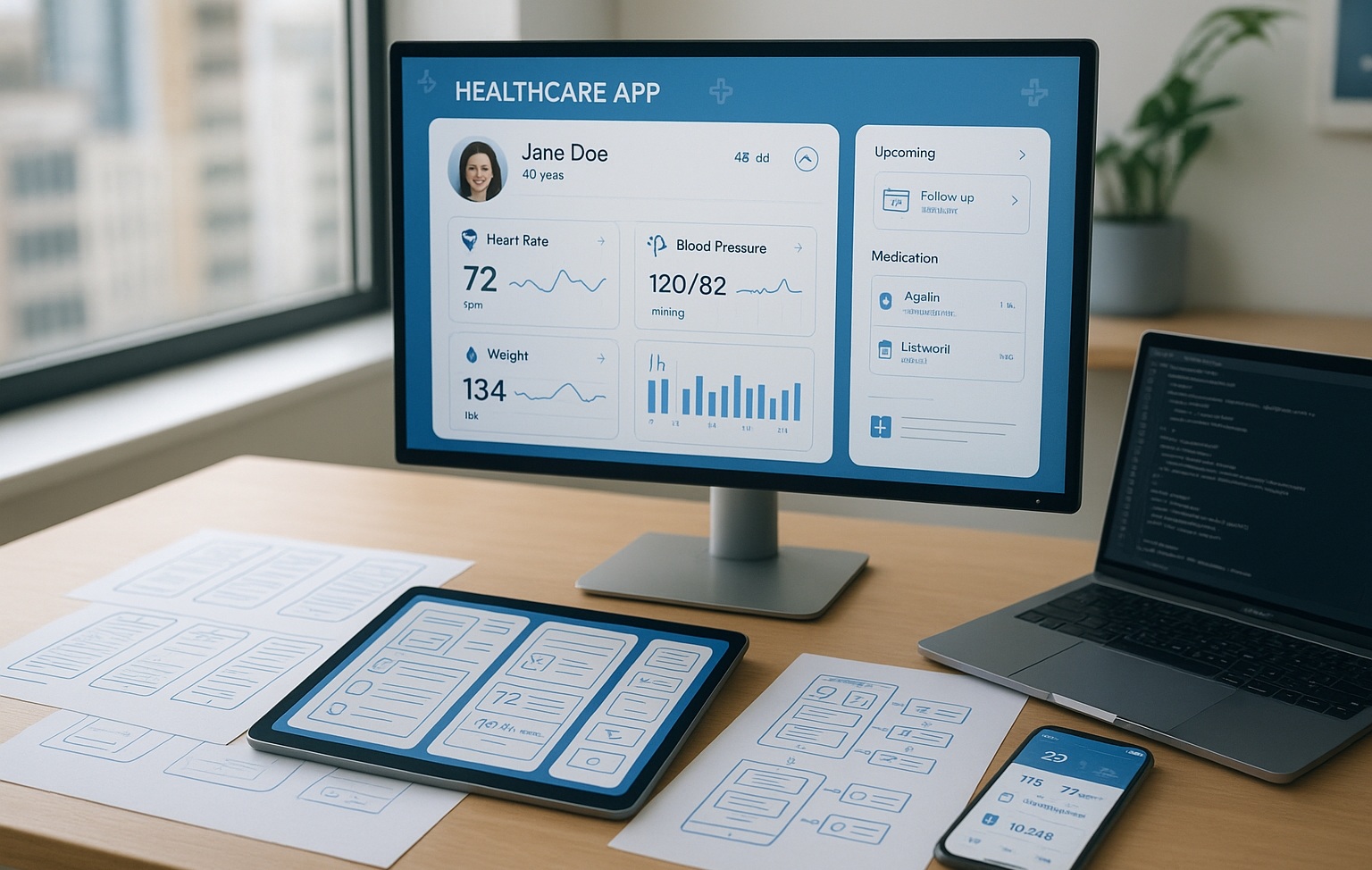
Prototyping Medical Apps Without Using Real Patient Data (Step-by-Step)
Healthcare apps must meet privacy laws like HIPAA and GDPR. Use synthetic, mock, de-identified data to build and test safely without exposing patients.
Why You Must Avoid Real Patient Data During Prototyping
Using real Protected Health Information (PHI) during app development creates significant legal and ethical risks. Under HIPAA regulations, any entity that stores, manages, records, or transmits PHI must comply with strict security and privacy standards. Even during the prototype phase, touching real patient data triggers full compliance requirements including:
- AES-256 encryption for data at rest and in transit
- Business Associate Agreements (BAAs) with all third-party services
- Comprehensive audit logging of all data access
- Multi-factor authentication and role-based access controls
- Regular security audits and risk assessments
- Breach notification procedures and incident response plans
The stakes are high: HIPAA violations can result in fines ranging from $100 to $50,000 per violation, with annual maximums reaching $1.5 million. Beyond financial penalties, data breaches erode patient trust and can permanently damage your organization's reputation.
💡 The Smart Approach
Apps that rely on users to supply their own health information may not require HIPAA compliance during prototyping. For example, a fitness tracking app where users manually input their weight and exercise data doesn't necessarily handle PHI from covered entities. However, once you integrate with Electronic Health Records (EHR) systems or receive data from healthcare providers, full compliance becomes mandatory.
Step-by-Step: Safe Medical App Prototyping Methods
Synthetic Data Generation
Synthetic data is artificially generated information that statistically mimics real patient data without containing any actual patient information. This approach offers the most realistic testing environment while maintaining complete privacy protection.
How it works: Advanced algorithms analyze the statistical properties, distributions, and correlations found in real healthcare data, then generate entirely new datasets that preserve these characteristics without copying actual records.
Key advantages:
- Statistically representative of real-world scenarios
- No privacy concerns or compliance requirements
- Can be generated in unlimited quantities
- Supports rare conditions and edge cases
- Enables comprehensive testing without legal risk
HIPAA Safe Harbor De-identification
The HIPAA Safe Harbor method provides a clear pathway to de-identify existing datasets by removing 18 specific types of identifiers. This method is particularly useful when you have access to real data that needs to be sanitized for development purposes.
The 18 identifiers that must be removed:
- Names (patients, relatives, employers)
- Geographic subdivisions smaller than state level
- All dates (except year) related to the individual
- Telephone and fax numbers
- Email addresses
- Social Security numbers
- Medical record numbers
- Health plan beneficiary numbers
- Account numbers
- Certificate/license numbers
- Vehicle identifiers and serial numbers
- Device identifiers and serial numbers
- Web URLs
- IP addresses
- Biometric identifiers (fingerprints, voiceprints)
- Full-face photographs
- Any other unique identifying number or code
Important note: After removing these identifiers, you must have no actual knowledge that the remaining information could be used alone or in combination to identify an individual.
Mock Data Tools and Libraries
Mock data generators provide quick, customizable fake data for rapid prototyping and user interface development. While not as statistically sophisticated as synthetic data, these tools excel at generating realistic-looking test data for UI/UX validation.
Best for: Initial wireframing, UI component testing, demo presentations, and early-stage development before implementing full synthetic data solutions.
FHIR Test Data and Sandbox Environments
Fast Healthcare Interoperability Resources (FHIR) is the modern standard for healthcare data exchange. Many EHR vendors provide FHIR sandbox environments with pre-populated test data specifically designed for app development.
Key benefits:
- Industry-standard data formats
- Pre-configured test patients and scenarios
- Real-world API integration testing
- No compliance concerns during development
- Vendor-provided documentation and support
Major FHIR sandbox providers include: Epic's App Orchard, Cerner's FHIR Sandbox, SMART Health IT, and Microsoft Azure API for FHIR.
Essential Tools for HIPAA-Safe Prototyping
Comparing Data Generation Approaches
| Method | Realism Level | Setup Complexity | Best Use Case |
|---|---|---|---|
| Synthetic Data (Synthea) | Very High | Medium | Comprehensive testing, clinical decision support, ML training |
| Safe Harbor De-identification | Highest | High | When starting with real data, research applications |
| Mock Data Tools | Medium | Low | UI/UX development, demos, rapid prototyping |
| FHIR Test Data | High | Low | EHR integration, interoperability testing |
Development Impact: By The Numbers
The Complete Prototyping Process
Phase 1: Requirements Definition
Before generating any test data, clearly define what your app needs to accomplish. Work with healthcare stakeholders—physicians, nurses, administrators, and patients—to understand clinical workflows, data requirements, and user expectations.
Key activities:
- Conduct stakeholder interviews and contextual inquiries
- Map out clinical workflows and user journeys
- Identify required data types and formats
- Document edge cases and error scenarios
- Establish success metrics and testing criteria
Phase 2: Synthetic Data Generation
Choose your data generation approach based on your specific needs. For comprehensive testing of clinical decision support systems, use Synthea to generate full patient histories. For UI development, simpler mock data tools may suffice.
Phase 3: Prototype Development
Build your application using the generated test data. Start with low-fidelity wireframes, progress to interactive prototypes, and eventually implement functional code. Throughout this process, continuously validate that your data handling remains HIPAA-safe.
Critical security considerations during prototyping:
- Never mix synthetic and real data in the same environment
- Implement encryption even for test data to establish good practices
- Use separate databases and storage for development vs. production
- Document all data flows and third-party integrations
- Conduct regular security reviews of prototype code
Phase 4: Stakeholder Testing
Engage medical professionals and potential users in testing your prototype with realistic scenarios. Studies show that apps developed with continuous stakeholder involvement achieve 65% higher adoption rates and experience 50% fewer post-launch issues.
Testing methodologies:
- Usability testing: Observe healthcare providers using the app in simulated workflows
- Clinical validation: Verify that medical logic and decision support features are accurate
- Accessibility testing: Ensure the app meets WCAG standards for users with disabilities
- Performance testing: Validate app responsiveness under realistic data loads
- Integration testing: Confirm compatibility with existing healthcare systems
Phase 5: Iteration and Refinement
Based on testing feedback, iterate on your prototype. The agile, iterative approach is particularly effective in healthcare app development, allowing for early detection of usability issues and continuous refinement based on real-world insights.
📊 Real-World Success Story
Mayo Clinic's 8-week prototyping process using synthetic patient data and involving nurses and patients reduced nursing alert fatigue by 40% and achieved a 95% user satisfaction rate. The iterative approach with stakeholder feedback led to a 45% reduction in critical issues during the first six months post-launch.
Best Practices for Safe Medical App Prototyping
- Start with compliance in mind: Even though you're not using real PHI, design your architecture as if you were. This makes the transition to production smoother and establishes security-first thinking in your development team.
- Use diverse synthetic data: Generate datasets that represent various demographics, conditions, and edge cases. Include rare diseases, complex medication regimens, and atypical patient profiles to ensure your app handles real-world diversity.
- Maintain clear data lineage: Document the source and generation method for all test data. This is crucial for regulatory submissions and helps prevent accidental mixing of synthetic and real data.
- Implement audit logging early: Even in prototypes, log all data access and modifications. This establishes good practices and provides valuable insights into how users interact with health information.
- Engage stakeholders continuously: Healthcare apps developed with ongoing clinical input are 2.5 times more likely to meet user needs and regulatory requirements. Schedule regular reviews with physicians, nurses, and administrators.
- Test realistic workflows: Don't just test happy paths. Use synthetic data to simulate emergency scenarios, medication conflicts, incomplete records, and system failures to ensure robust error handling.
- Validate clinical accuracy: Have medical professionals review any clinical decision support logic, drug interaction warnings, or diagnostic suggestions. Inaccurate medical information can cause real harm, even in prototypes.
- Plan for production transition: Design your data layer to easily swap synthetic data sources with HIPAA-compliant production databases. Use abstraction layers and dependency injection to minimize code changes during the transition.
⚠️ Common Pitfalls to Avoid
- Don't use slightly modified real data: Simply changing names or dates in real patient records doesn't make data safe. Re-identification techniques can still expose patients.
- Avoid public datasets without verification: Some publicly available "de-identified" healthcare datasets have been successfully re-identified. Verify the source and de-identification methods.
- Don't skip security in prototypes: Bad security practices established during prototyping often carry over to production. Build secure habits from day one.
- Never share prototype data externally: Even synthetic data can contain clues about your app's functionality and architecture. Limit access to authorized team members only.
Ready to Build Your HIPAA-Safe Healthcare App?
Our team specializes in developing secure, compliant medical applications using cutting-edge prototyping methods. Let's discuss your project and create a development strategy that protects patient privacy while delivering exceptional user experiences.
Moving from Prototype to Production
Once your prototype has been validated with stakeholders and refined through iterative testing, you're ready to transition to production development. This critical phase requires careful planning to maintain security while shifting from synthetic to real patient data.
Production Readiness Checklist
- Complete HIPAA Security Risk Assessment: Document all potential vulnerabilities and implement appropriate safeguards.
- Establish Business Associate Agreements: Ensure all third-party services (cloud hosting, analytics, etc.) have signed BAAs.
- Implement production-grade encryption: Use AES-256 for data at rest, TLS 1.2+ for data in transit.
- Configure comprehensive audit logging: Track all PHI access with timestamps, user IDs, and action types.
- Deploy multi-factor authentication: Require MFA for all users accessing patient data.
- Establish role-based access controls: Implement principle of least privilege for data access.
- Create incident response procedures: Document breach notification processes and response protocols.
- Schedule regular security audits: Plan for penetration testing and vulnerability assessments.
- Train staff on HIPAA compliance: Ensure all team members understand their obligations.
Data Migration Strategy
Transitioning from synthetic to real patient data requires a phased approach:
- Parallel testing: Run production code with synthetic data alongside your prototype to identify any behavioral differences.
- Pilot deployment: Start with a small group of test users and limited real data before full rollout.
- Gradual expansion: Incrementally increase user base and data volume while monitoring for issues.
- Continuous validation: Compare production metrics against prototype performance benchmarks.
- Rollback capability: Maintain ability to quickly revert to previous versions if critical issues emerge.
The Future of Medical App Development
As healthcare technology continues to evolve, the tools and techniques for safe prototyping are becoming increasingly sophisticated. Emerging trends include:
- AI-powered synthetic data generation: Machine learning models that create even more realistic patient scenarios and rare condition simulations.
- Federated learning: Training AI models on distributed real data without centralization or PHI exposure.
- Privacy-preserving computation: Homomorphic encryption and secure multi-party computation enabling analysis of encrypted health data.
- Differential privacy: Mathematical frameworks that add controlled noise to datasets, enabling safe data sharing while preserving individual privacy.
- Blockchain for consent management: Decentralized systems giving patients granular control over their health data usage.
These innovations will make it even easier to develop and test healthcare applications without compromising patient privacy, accelerating the pace of innovation while maintaining the highest ethical standards.
Explore Real-World Healthcare App Success Stories
See how leading healthcare organizations are using safe prototyping methods to build innovative patient care solutions.
View Use CasesConclusion: Building Better Healthcare Apps Safely
Prototyping medical applications without real patient data isn't just about compliance—it's about building better products. By using synthetic data, de-identification techniques, and purpose-built testing tools, developers can:
- Iterate faster without regulatory delays
- Test edge cases and rare conditions impossible to encounter in limited real datasets
- Engage stakeholders earlier without privacy concerns
- Build security-first architectures from the ground up
- Focus on user experience without the burden of production-level security during early development
The statistics speak for themselves: apps developed using iterative prototyping with stakeholder input achieve 40% higher user satisfaction, 65% higher adoption rates, and 50% fewer post-launch critical issues. Healthcare organizations using these methods have seen dramatic improvements in patient outcomes, including 30% fewer medication errors and 35% better patient engagement.
As healthcare continues its digital transformation, the ability to rapidly prototype and test new ideas will become increasingly critical. By mastering these safe prototyping techniques today, you're not just avoiding compliance risks—you're positioning yourself to deliver the next generation of healthcare innovation.
Remember: The goal isn't to avoid real patient data forever. It's to use the prototyping phase to build a solid, well-tested foundation that's ready to handle real PHI securely when the time comes. Start safe, iterate quickly, and transition to production with confidence.
🚀 Take the Next Step
Whether you're building your first healthcare app or adding new features to an existing platform, proper prototyping with synthetic data will accelerate your development timeline while ensuring patient privacy remains paramount. The tools and techniques outlined in this guide provide everything you need to get started today.
This guide reflects current best practices as of 2025. Always consult with healthcare compliance experts and legal counsel for your specific situation, as regulations and standards continue to evolve.